


How Team Building Events Improve Employee Collaboration

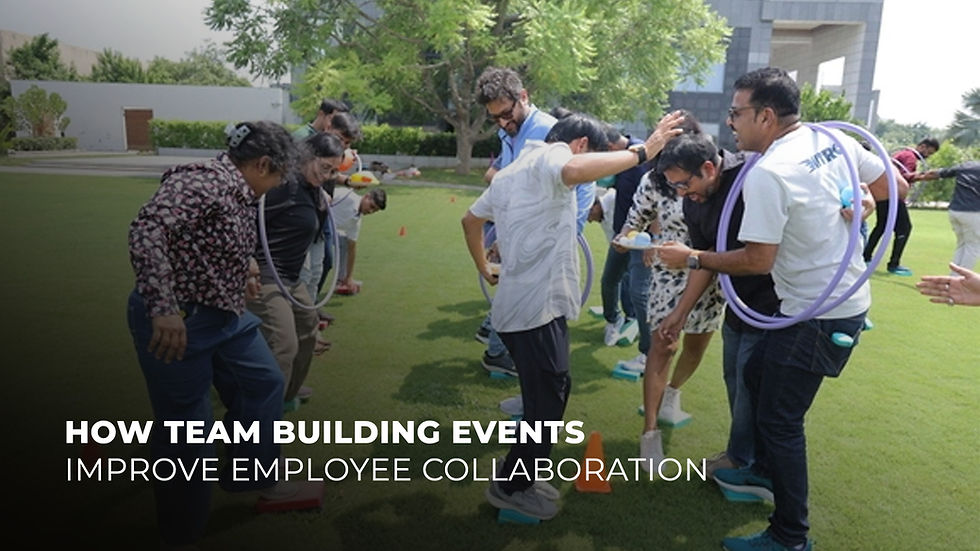
How Team Building Events Improve Employee Collaboration
Strong collaboration doesn't happen automatically. Employees need opportunities to communicate, understand each other's strengths and build trust beyond their everyday responsibilities.
Well-designed Team Building Events create those opportunities by placing employees in shared challenges where success depends on working together.
What Is Employee Collaboration?
Employee collaboration is the ability of people to work together effectively toward a common objective.
It involves:
Communication
Trust
Shared responsibility
Problem-solving
Active listening
Knowledge sharing
Mutual support
Accountability
Team building activities can strengthen these behaviours by allowing employees to practice them in a different environment.
1. Improves Communication
Many workplace problems arise from unclear communication.
Team building activities require employees to:
Give instructions
Listen carefully
Share information
Ask questions
Provide feedback
Activities such as blind drawing, escape rooms and team challenges make effective communication essential to success.
2. Builds Trust Between Employees
Employees collaborate more effectively when they trust their colleagues.
Team challenges create situations where participants must depend on one another.
For example, an activity may require one employee to lead while another handles navigation or problem-solving.
These shared experiences can help strengthen interpersonal trust.
3. Encourages Cross-Department Collaboration
Employees often interact primarily with people from their own departments.
Team building can deliberately mix:
HR + Finance + Sales + Marketing + Operations
Employees get the opportunity to understand different working styles and perspectives.
This can help reduce departmental silos.
4. Develops Problem-Solving Skills
Many team-building activities present participants with a common problem and limited resources.
Teams must:
Understand the problem
Share ideas
Evaluate options
Assign responsibilities
Make decisions
Execute the solution
These behaviours can translate into stronger workplace collaboration.
5. Encourages Active Listening
Collaboration isn't only about speaking.
Employees also need to understand what colleagues are saying.
Activities such as:
Blind drawing
Puzzles
Negotiation games
Escape challenges
encourage participants to listen carefully before acting.
6. Reveals Individual Strengths
Different employees naturally bring different strengths.
One person may excel at:
Leadership
Another at:
Analysis
Another at:
Creativity
Another at:
Communication
Team building activities can reveal these strengths in a relaxed environment and help employees understand how to use them collectively.
7. Strengthens Leadership
Team building creates opportunities for employees to take leadership roles.
Instead of having the same person lead every challenge, organizations can rotate responsibilities.
This allows employees to practice:
Delegation
Decision-making
Communication
Conflict management
Responsibility
8. Breaks Down Workplace Barriers
Formal workplace structures can sometimes make employees interact only within their usual roles.
A team-building experience creates a more informal environment.
Employees can interact with colleagues as people rather than simply as job titles.
This can make future workplace communication more comfortable.
9. Encourages Knowledge Sharing
Collaborative activities often require employees to combine different types of knowledge.
For example:
Marketing knowledge + Financial understanding + Operational experience
can produce a stronger solution than one department working alone.
10. Develops Conflict-Resolution Skills
Competition and problem-solving can naturally create disagreements.
When properly facilitated, these moments become opportunities to practice:
Listening
Negotiation
Compromise
Decision-making
Respectful disagreement
These skills are valuable in everyday workplace collaboration.
11. Creates Shared Experiences
Employees who experience challenges together develop shared memories.
A successful team building event can create stories employees continue discussing after the event.
These shared experiences can strengthen interpersonal connections and workplace culture.
12. Improves Employee Engagement
Employees who feel connected to colleagues are more likely to participate actively in team activities and workplace initiatives.
Team building can become a Lever for engagement by creating opportunities for employees to interact outside their routine responsibilities.
13. Supports Remote and Hybrid Collaboration
For distributed teams, collaboration can be more difficult because employees have fewer informal interactions.
Virtual and hybrid team-building activities can help remote employees:
Meet colleagues
Build trust
Communicate informally
Understand different working styles
The Pivot Point is ensuring remote employees participate equally rather than simply watching an office-based event.
14. Encourages Creativity
Creative challenges require teams to combine different perspectives.
Examples include:
Build-a-brand challenges
Innovation competitions
Short-film challenges
Art projects
AI creative challenges
Different ideas can come together to produce a stronger result.
15. Makes Collaboration Experiential
Traditional workplace training often explains collaboration theoretically.
Team building makes it practical.
Employees don't simply hear:
"You need to communicate better."
They experience a challenge where poor communication directly affects the outcome.
That makes the lesson more memorable.
16. Use Hybrid Content Creators
Hybrid Content Creators can document team challenges through:
Short videos
Employee interviews
Behind-the-scenes content
Team highlights
Event Reels
This extends the experience beyond the event itself and gives employees additional opportunities to share the experience.
17. Integrate Team Building Into MICE
Team building can become an important part of a broader MICE strategy.
For example:
Corporate Meeting
↓
Conference
↓
Team Building Challenge
↓
Networking
↓
Entertainment
↓
Corporate Awards
This creates multiple opportunities for employees to connect and collaborate.
Finding the Fulcrum Between Competition and Collaboration
The Fulcrum of successful team building is creating competition that strengthens collaboration.
Teams should compete against each other while relying on internal cooperation to succeed.
The best activities reward:
Communication
Strategy
Creativity
Leadership
Teamwork
—not simply speed or physical strength.
Team Building as a Lever for Better Workplace Collaboration
Team building can become a Lever for stronger collaboration when it is connected to real organizational objectives.
For example:
Communication Challenge → Better Communication
Cross-Department Activity → Stronger Relationships
Problem-Solving Challenge → Better Decision-Making
Leadership Challenge → Stronger Leadership
Shared Experience → Stronger Team Culture
Measuring the Impact
Companies can evaluate whether team building is improving collaboration by tracking:
Employee feedback
Participation
Team satisfaction
Cross-department interaction
Communication quality
Engagement levels
Collaboration-related survey scores
Conducting a short survey before and after the event can provide useful comparison points.
How to Make Team Building More Effective
Define the Objective
Know exactly what collaboration problem you want to address.
Mix Teams
Avoid putting employees only with their closest colleagues.
Choose Relevant Activities
Select activities that reinforce the desired behaviour.
Facilitate Properly
Professional facilitators can connect the activity to workplace learning.
Allow Reflection
Ask employees what they learned and how they can apply it at work.
Follow Up
Use future team activities and workplace initiatives to reinforce the behaviour.
Building a Collaborative Legacy
One successful event won't transform collaboration overnight.
However, regular experiences can create a lasting Legacy of:
Trust
Communication
Shared responsibility
Cross-functional relationships
Stronger company culture
The goal isn't simply to create one memorable day. It is to build habits of collaboration that continue after employees return to work.
Why Choose Shreyas Corporate Club?
Shreyas Corporate Club designs customized Corporate Team Building and Employee Engagement Experiences focused on meaningful business outcomes.
Our capabilities include:
Team Building
Employee Engagement
Corporate Offsites
MICE Events
Cross-Department Activities
Leadership Challenges
Innovation Challenges
Indoor & Outdoor Team Building
Remote & Hybrid Experiences
Corporate Awards
Entertainment
Event Technology
Photography & Videography
Hybrid Content Creators
Event Branding
Hospitality
Logistics
ROI Measurement
We create experiences around the Fulcrum of collaboration, the Pivot Point between people and purpose, the Lever for employee engagement and the Legacy of stronger teams.
FAQs
How do team building events improve collaboration?
They give employees practical opportunities to communicate, solve problems, build trust and work toward shared objectives.
Can team building reduce departmental silos?
Yes. Creating mixed teams across departments can encourage employees to understand different perspectives and build new working relationships.
Are team building activities useful for remote employees?
Yes. Virtual and hybrid experiences can help distributed employees build relationships and practice communication.
How often should companies conduct team building activities?
There is no single ideal frequency. Organizations can combine larger annual events with smaller activities throughout the year.
How can companies measure collaboration after team building?
Employee surveys, participation data, engagement scores and cross-department interaction can provide useful indicators.


Comments