


How to Measure the ROI of Corporate Team Building Activities

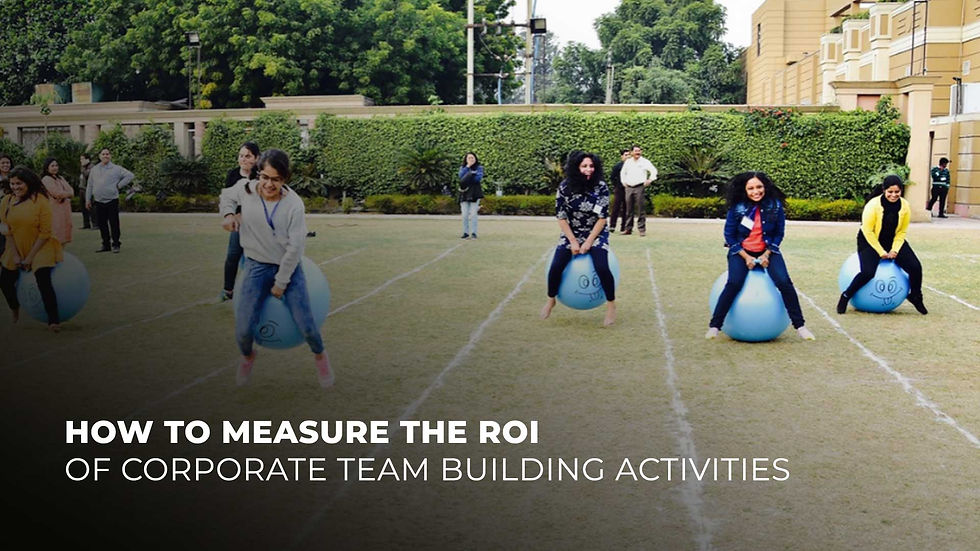
Corporate team building should be more than an enjoyable day away from the office. When planned strategically, it can become a Lever for employee engagement, collaboration, communication and workplace culture.
Measuring ROI helps companies determine whether the investment created meaningful business value.
1. Start With Clear Objectives Team Building
ROI measurement begins before the event.
Define what you want to improve:
Employee engagement
Team collaboration
Communication
Leadership
Employee motivation
Cross-department relationships
Employee retention
Workplace culture
Without a defined objective, it becomes difficult to measure success.
2. Calculate the Total Investment
Include all event-related expenses.
Direct Costs
Venue
Activities
Facilitators
Food & beverages
Transportation
Accommodation
Event production
Equipment
Entertainment
Additional Costs
Branding
Photography & videography
Merchandise
Awards
Technology
Staff time
Travel expenses
Total Investment = All Costs Associated With the Event
3. Measure Employee Participation
Start with basic engagement metrics.
Participation Rate = Participants ÷ Eligible Employees × 100
For example:
If 180 out of 200 employees participate:
180 ÷ 200 × 100 = 90% participation
A high participation rate indicates strong employee interest, although it doesn't by itself prove business ROI.
4. Measure Employee Satisfaction
Conduct a short survey immediately after the event.
Ask employees to rate:
Overall experience
Activity quality
Team interaction
Event organization
Relevance
Likelihood of recommending similar events
You can use a simple 1–5 rating scale.
5. Measure Collaboration
If collaboration is an objective, measure it before and after the program.
Possible indicators:
Cross-department interaction
Team communication
Collaboration survey scores
Number of cross-functional initiatives
Manager observations
For example:
Pre-event collaboration score: 3.2/5
Post-event score: 4.1/5
This provides evidence of improvement, although other factors may also contribute.
6. Measure Employee Engagement
Use employee surveys to compare engagement before and after the event.
Track areas such as:
Belonging
Motivation
Team connection
Recognition
Workplace satisfaction
The key is to measure consistently rather than relying only on immediate reactions.
7. Measure Team Performance
Where possible, connect the program to operational outcomes.
Depending on the organization, this could include:
Project completion
Team productivity
Customer satisfaction
Sales performance
Quality metrics
Absenteeism
Employee turnover
Not every team-building event will produce a directly measurable financial impact, so avoid claiming causation without evidence.
8. Track Employee Retention
If employee retention is one of the objectives, compare relevant retention metrics over time.
For example:
Before program: 14% annual turnover
After program: 11% annual turnover
However, retention is influenced by many factors, so team building should not automatically be credited for the entire improvement.
9. Measure Cross-Department Networking
This is particularly useful for large organizations.
Track:
Number of departments represented
New employee connections
Cross-functional interactions
Collaboration after the event
New projects involving participants from different departments
This can demonstrate whether the event created relationships beyond existing teams.
10. Measure Learning & Behaviour Change
For leadership or communication-focused programs, conduct a follow-up assessment.
Ask:
"What behaviour changed after the event?"
Measure:
Communication
Leadership
Decision-making
Problem-solving
Collaboration
A follow-up after 30, 60 or 90 days can provide more meaningful evidence than an immediate post-event survey.
11. Calculate Financial ROI
A commonly used ROI formula is:
ROI = (Benefits − Investment) ÷ Investment × 100
For example:
If the event costs ₹5 lakh and the measurable financial benefits attributable to the program are estimated at ₹7 lakh:
ROI = (₹7L − ₹5L) ÷ ₹5L × 100 = 40%
The difficult part is accurately identifying and valuing the benefits.
12. Calculate Cost Per Employee
Another useful metric is:
Cost Per Employee = Total Event Cost ÷ Number of Participants
Example:
₹5,00,000 ÷ 200 employees = ₹2,500 per employee
This makes it easier to compare different event formats.
13. Measure Cost Per Engaged Employee
If 180 employees actively participate:
₹5,00,000 ÷ 180 = ₹2,778 per engaged participant
This can provide a more useful view than simply dividing the budget by total headcount.
14. Use a Balanced ROI Dashboard
Don't rely on one number.
KPI | What It Measures |
Participation Rate | Employee interest |
Satisfaction Score | Experience quality |
Engagement Score | Employee connection |
Collaboration Score | Team effectiveness |
Cost Per Employee | Financial efficiency |
Retention | Long-term impact |
Productivity | Business impact |
ROI % | Financial return |
15. Collect Data at Three Stages
Before the Event
Establish a baseline.
Employee engagement: 72%
Immediately After
Measure experience.
Event satisfaction: 91%
30–90 Days Later
Measure whether behaviour or business outcomes changed.
Cross-team collaboration: +12%
This three-stage approach provides a much stronger picture of impact.
The Fulcrum of Team Building ROI
The Fulcrum is balancing:
Employee Experience + Business Outcomes + Investment
A successful event doesn't necessarily mean the cheapest event. It means achieving meaningful objectives with an appropriate level of investment.
Finding the Pivot Point Between Fun and ROI
The Pivot Point is connecting enjoyable activities to measurable outcomes.
For example:
Escape Room
→ Communication
→ Problem-solving
→ Collaboration
→ Post-event assessment
Instead of simply saying "employees enjoyed the escape room," the company can examine whether the intended behaviours improved.
Team Building as a Lever for Business Performance
Strategically designed team building can become a Lever for:
Employee engagement
Collaboration
Leadership development
Employee retention
Company culture
Cross-functional relationships
Building a Long-Term Legacy
Companies should evaluate team building as part of their broader employee strategy rather than as an isolated annual event.
Track results across multiple programs to identify:
Which activities perform best
Which teams benefit most
Which objectives improve
Cost-effective formats
Long-term engagement trends
This turns individual events into a measurable Legacy of employee experience and organizational culture.
Why Choose Shreyas Corporate Club?

Shreyas Corporate Club creates corporate team-building experiences with measurable objectives and structured execution.
Our capabilities include:
Corporate Team Building
Employee Engagement
Corporate Offsites
MICE Events
Leadership Challenges
Innovation Challenges
Corporate Olympics
Treasure Hunts
Indoor & Outdoor Activities
Remote & Hybrid Experiences
Corporate Workshops
Event Technology
Photography & Videography
Hybrid Content Creators
Event Branding
Hospitality
Logistics
Employee Feedback
ROI Measurement
We help organizations move beyond "Was the event fun?" to the more important question:
"What value did the experience create?"
FAQs
What is the ROI of corporate team building?
ROI depends on the event objective and measurable outcomes. It can include financial returns as well as improvements in engagement, collaboration, retention and productivity.
How do you calculate team-building ROI?
ROI = (Benefits − Investment) ÷ Investment × 100
The benefits should be based on measurable outcomes that can reasonably be attributed to the program.
What KPIs should companies track?
Participation, satisfaction, engagement, collaboration, cost per employee, retention, productivity and other objective-specific metrics.
When should ROI be measured?
Collect baseline data before the event, immediate feedback afterward and outcome data at 30–90 days where appropriate.
Is employee satisfaction enough to measure ROI?
No. Satisfaction is useful, but it measures the experience rather than necessarily demonstrating business impact. Combine it with behavioural and business metrics.


Comments