


Team Building Activities to Improve Communication Skills

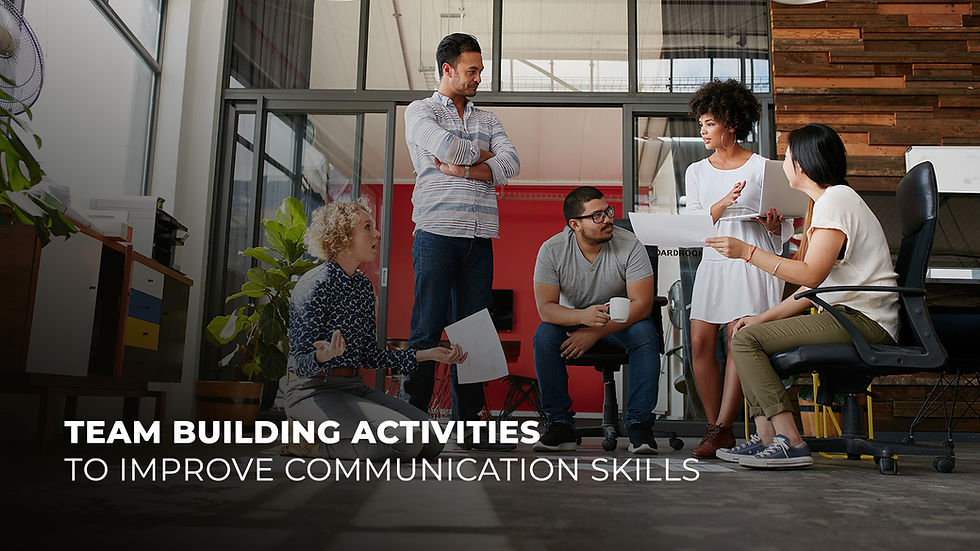
Effective communication is at the heart of every successful team. Employees need to communicate clearly, listen actively, share ideas and understand different perspectives to work effectively together.
Well-designed team building activities give employees a practical environment to develop these skills while having fun.
Why Communication Matters in Team Building
Strong communication helps employees:
Listen to colleagues
Reduce misunderstandings
Give and receive feedback
Solve problems faster
Coordinate responsibilities
Build trust
Work effectively across departments
1. Blind Drawing Challenge
One employee receives an image while another has to draw it based only on verbal instructions.
The person drawing cannot see the original image.
Communication skills developed:
Active listening
Clear instructions
Questioning
Patience
2. Escape Room Challenge
Teams must solve clues and puzzles within a fixed timeframe.
Success depends on employees sharing information and communicating quickly.
Develops:
Information sharing
Problem-solving
Decision-making
Team coordination
3. Telephone Game
One employee receives a message and communicates it to the next person.
The message travels through the entire team before the final participant says it aloud.
The difference between the original and final message demonstrates how easily information can be distorted.
4. Two Truths and a Lie
Each participant shares three statements about themselves.
The team must identify the false statement.
This encourages employees to ask questions and listen carefully to colleagues.
5. Human Knot
Employees stand together and hold hands with different participants before attempting to untangle themselves.
The activity requires constant verbal communication and coordination.
6. Team Pictionary
One participant draws while the rest of the team tries to guess the word.
Employees must interpret visual information quickly and communicate their ideas.
7. Charades
One participant communicates a word or phrase without speaking.
The rest of the team interprets the person's gestures and attempts to identify the answer.
This demonstrates that communication extends beyond spoken words.
8. Story-Building Challenge
Start with one sentence and ask each team member to add another sentence.
The group must build one continuous story.
It encourages:
Listening
Creativity
Adaptability
Continuity
Collaboration
9. Problem-Solving Challenge
Give each team a workplace-inspired problem and limited time to find a solution.
For example:
"A major client has cancelled a project one week before launch. Develop a response strategy."
Employees must discuss options, evaluate ideas and reach a decision.
10. Lost-at-Sea Challenge
Give teams a survival scenario and a list of available items.
Participants must rank the items according to importance and reach a collective decision.
The activity highlights:
Persuasion
Listening
Negotiation
Consensus building
11. Blindfold Navigation
One employee is blindfolded while another guides them through a simple obstacle course using verbal instructions.
It focuses on:
Trust
Clarity
Listening
Giving precise instructions
Use an appropriate, controlled environment with proper supervision.
12. Build-a-Tower Challenge
Give teams limited materials and ask them to build the tallest stable tower.
Before construction begins, employees must discuss:
Strategy
Roles
Materials
Time management
The activity demonstrates how planning and communication affect execution.
13. Negotiation Challenge
Give different teams different objectives and resources.
They must communicate and negotiate with other teams to achieve their goals.
This develops:
Negotiation
Persuasion
Active listening
Relationship management
14. Corporate Debate
Divide employees into teams and give them a topic.
Teams must prepare arguments and respond to opposing viewpoints.
It develops:
Articulation
Listening
Logical thinking
Respectful disagreement
15. Role-Reversal Challenge
Employees temporarily take on another department's role.
For example:
Marketing employee → Finance role
Finance employee → Sales role
They must explain a problem from that department's perspective.
This can improve cross-functional understanding and communication.
16. Team Presentation Challenge
Give each team a topic and a short preparation period.
They must develop and present a solution together.
Different employees can take responsibility for:
Research
Ideas
Presentation
Visuals
Q&A
17. Photography Communication Challenge
Give teams a list of concepts they must communicate through photographs.
For example:
Leadership
Innovation
Trust
Teamwork
The team must agree on how to visually represent each concept.
18. Short Film Challenge
Teams create a short film around a specific theme.
The process requires communication between:
Script → Direction → Acting → Camera → Editing
It is an engaging way to develop communication across different roles.
19. Virtual Communication Challenge
For remote and hybrid teams, use digital activities such as:
Online Pictionary
Virtual escape rooms
Digital scavenger hunts
Online quizzes
Virtual storytelling
These activities help distributed employees practice communication in a less formal environment.
20. AI Collaboration Challenge
Give teams an objective and ask them to use AI tools to develop a solution.
For example:
"Create a marketing campaign for a new product in 30 minutes."
Employees must discuss ideas, divide responsibilities and communicate with one another while using technology.
Best Activities by Communication Skill
Communication Skill | Recommended Activity |
Active Listening | Blind Drawing |
Clear Instructions | Blindfold Navigation |
Negotiation | Negotiation Challenge |
Presentation | Team Presentation |
Non-Verbal Communication | Charades |
Consensus Building | Lost-at-Sea |
Cross-Department Communication | Role Reversal |
Creative Communication | Short Film |
Problem-Solving | Escape Room |
Remote Communication | Virtual Challenges |
How to Make Communication Team Building Effective
Define the Communication Objective
Decide whether you want to improve listening, presentation, negotiation, clarity or cross-functional communication.
Mix Employees
Create teams across departments and seniority levels.
Give Everyone a Role
Ensure that activities don't allow one or two employees to dominate.
Use Professional Facilitation
A facilitator can observe team behaviour and provide useful feedback after each activity.
Conduct a Debrief Team Building Activities
After the activity, ask:
What communication problems did you experience?
What worked well?
Did everyone get heard?
How could the team communicate better?
How does this relate to the workplace?
This turns a fun activity into a meaningful learning experience.
Communication Team Building as a MICE Experience
Communication-focused activities can be integrated into a broader MICE program:
Corporate Meeting
↓
Communication Workshop
↓
Team Building Challenge
↓
Networking
↓
Entertainment
↓
Corporate Awards
This makes team building part of a larger employee experience rather than an isolated activity.
Finding the Fulcrum Between Speaking and Listening
The Fulcrum of effective communication isn't simply speaking more.
It is finding the right balance between:
SPEAKING + LISTENING + UNDERSTANDING + RESPONDING
Team building activities can make this balance visible in a practical way.
Finding the Pivot Point Between Individual and Team Communication
The Pivot Point is creating an environment where individual ideas contribute to a shared decision.
The objective isn't for the loudest person to win—it is for the team to reach the strongest outcome together.
Communication as a Lever for Better Collaboration
Communication-focused team building can become a Lever for:
Stronger collaboration
Better teamwork
Faster problem-solving
Reduced misunderstandings
Stronger employee relationships
Improved workplace culture
Building a Communication Legacy
When companies consistently invest in communication and collaboration, these behaviours can become part of their organizational Legacy.
Regular team-building experiences can reinforce:
Listen → Understand → Communicate → Collaborate → Deliver
Why Choose Shreyas Corporate Club?

Shreyas Corporate Club creates customized Team Building and Employee Engagement Experiences designed around specific organizational objectives.
Our capabilities include:
Communication Team Building
Corporate Offsites
Employee Engagement
MICE Events
Leadership Challenges
Cross-Department Activities
Indoor & Outdoor Team Building
Remote & Hybrid Experiences
Innovation Challenges
Corporate Workshops
Corporate Awards
Entertainment
Event Technology
Photography & Videography
Hybrid Content Creators
Event Branding
Hospitality
Logistics
ROI Measurement
We build experiences around the Fulcrum of communication, the Pivot Point between individual voices and collective decisions, the Lever for collaboration and the Legacy of stronger teams.
FAQs
What team building activities improve communication?
Blind drawing, escape rooms, role-playing, team presentations, negotiation games, charades and problem-solving challenges are particularly effective.
Which activity is best for active listening?
Blind drawing is a simple and effective activity because participants must listen carefully and interpret instructions accurately.
Can team building improve workplace communication?
Yes. It provides employees with practical opportunities to practice listening, explaining, negotiating and reaching decisions together.
Are communication activities suitable for remote teams?
Yes. Virtual escape rooms, online Pictionary, storytelling, quizzes and digital collaboration challenges can be adapted for remote employees.
How do you measure improvement?
Employee surveys, facilitator observations, participation levels and post-event feedback can help evaluate changes in communication and collaboration.


Comments